Don't miss our holiday offer - 20% OFF!
Florida Sheepshead Fishing: Complete Inshore Guide
Florida sheepshead are hard-fighting inshore fish commonly found around docks, bridges, oyster bars, seawalls, jetties, and fishing piers. Learn how tides, current, structure, seasonal patterns, and feeding behavior can help you locate sheepshead—and discover the baits, artificial lures, and techniques used to catch them throughout Florida.
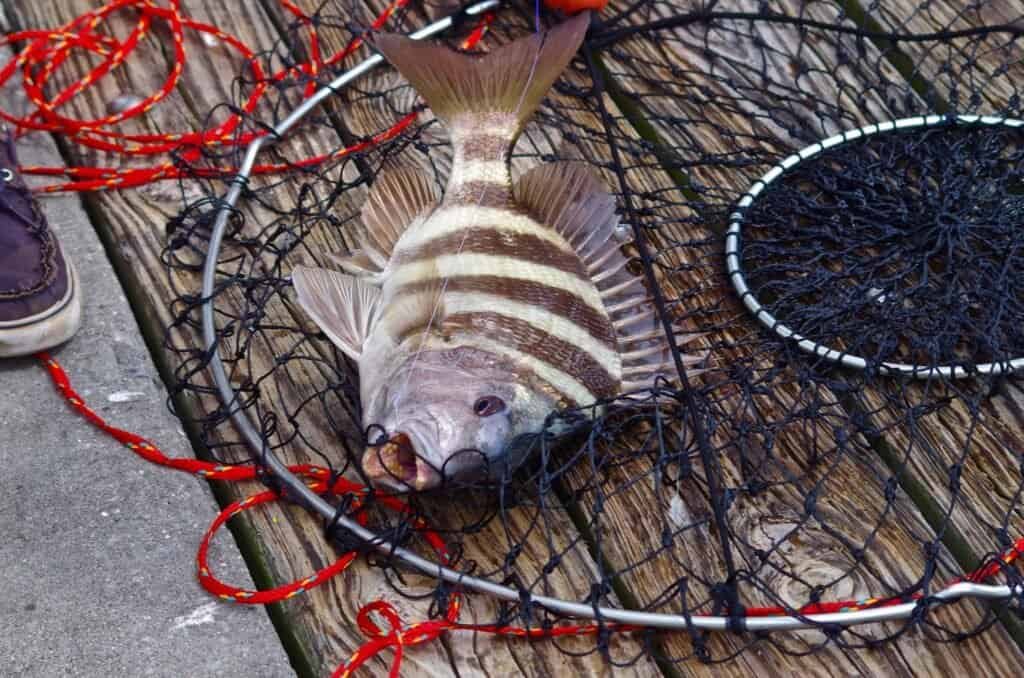
Florida sheepshead are one of the most recognizable—and sometimes frustrating—inshore fish in the state.
Their bold black-and-silver vertical stripes make them easy to identify, but it’s their unusual teeth and reputation for stealing bait that have made sheepshead famous among Florida anglers.
They’re also perfectly suited to Florida’s inshore environment.
Sheepshead spend much of their time around hard structure where barnacles, crabs, shrimp, oysters, and other small organisms provide a dependable food supply. Bridges, docks, seawalls, oyster bars, jetties, pilings, and piers can all hold fish.
That creates opportunities for nearly every type of Florida angler.
You don’t necessarily need a boat.
A productive dock, bridge, seawall, or fishing pier may provide access to the same fish boat anglers are targeting around nearby structure.
Catching sheepshead consistently, however, requires understanding how they feed.
These aren’t usually fish you’re going to chase across acres of open grass with a fast-moving search bait. Sheepshead fishing is much more about structure, current, precise lure placement, and detecting subtle bites.
What Is a Sheepshead?
The sheepshead (Archosargus probatocephalus) is a member of the porgy family and occurs throughout Florida’s coastal waters.
The species is easily recognized by its silvery body crossed by several dark vertical bars.
Those stripes have earned sheepshead another common nickname:
Convict fish.
But the feature anglers remember most is the mouth.
Sheepshead possess prominent front teeth along with specialized crushing teeth farther inside the mouth. This allows them to scrape, crush, and consume hard-shelled prey associated with docks, oysters, pilings, rocks, and other structure.
Their diet commonly includes:
- Crabs
- Fiddler crabs
- Shrimp
- Barnacles
- Oysters and other mollusks
- Marine worms
- Small crustaceans
That diet tells us a great deal about where to find them.
Where Sheepshead Live in Florida
If you’re looking for sheepshead, start with hard structure.
Structure provides both habitat and food, and some of Florida’s most ordinary-looking docks and bridge pilings can support surprisingly good fishing.
Docks
Docks are classic sheepshead habitat.
Pilings accumulate barnacles and other marine growth while providing shade, current breaks, and vertical structure.
Look closely around:
- Barnacle-covered pilings
- Deep corners
- Current-facing pilings
- Shaded areas
- Dock ends
- Nearby drop-offs
The fish may be holding extremely close to the structure.
That makes accurate presentations important.
Bridge Pilings
Bridges combine several things sheepshead like:
Hard structure + marine growth + depth + current.
Pilings interrupt tidal flow and create current breaks where fish can hold while food moves past.
The challenge is keeping your presentation in the strike zone without being swept away by the current.
Jig weight becomes especially important here.
Too light and you never reach the fish.
Too heavy and the presentation becomes unnecessarily unnatural or constantly hangs in structure.
Oyster Bars
Oyster bars create an obvious feeding environment for a fish built to eat crustaceans and shellfish.
Sheepshead can patrol submerged oyster edges and shell-covered bottom looking for small crabs, shrimp, and other organisms.
Concentrate on:
- Submerged edges
- Oyster points
- Cuts
- Deeper sides
- Current seams
- Adjacent channels
As with redfish, don’t assume the visible oysters represent the entire structure.
Much of the productive shell may remain underwater.
Seawalls
Older seawalls can accumulate barnacles, oysters, and other marine growth.
That effectively turns the wall into a vertical feeding area.
Look for sections with:
- Visible marine growth
- Current
- Depth
- Nearby docks
- Corners
- Drainage or water movement
Fish may hold extremely close to the wall, so presentations should often remain near the structure rather than several feet away.
Jetties and Rocks
Rock jetties provide enormous amounts of hard surface area for barnacles, crabs, and other organisms.
They also interact with waves and current to create feeding opportunities.
Sheepshead may hold around submerged rocks, deeper edges, and current breaks.
Snags are inevitable in this environment, so maintaining lure control is critical.
Fishing Piers
Sheepshead are an excellent target for Florida pier anglers.
Pier pilings can develop extensive marine growth while extending through several depths and current zones.
Instead of automatically casting as far away from the pier as possible, look directly below you.
The fish may be feeding on the structure you’re standing on.
This is an important concept we’ll explore much more deeply in our Florida Sheepshead Pier Fishing guides.
Why Structure Is So Important
For sheepshead, structure isn’t simply somewhere to hide.
It’s the dinner table.
A mature dock piling or bridge support may be covered with barnacles, oysters, mussels, and other organisms. Crabs and shrimp move throughout this environment.
Tidal current continually delivers additional food.
That means sheepshead can remain near relatively small pieces of productive structure rather than constantly traveling across large areas searching for prey.
When evaluating structure, ask three questions:
Is there food growing on it?
Is there enough water for fish to comfortably use it?
Is current moving food past it?
When all three are present, investigate carefully.
Understanding Current for Sheepshead
Current is one of the most important factors in sheepshead fishing.
Moving water carries food while creating predictable areas where fish can position around structure.
A piling, for example, divides current.
Water accelerates around the sides while slower water develops behind the obstruction.
Sheepshead can hold close to the structure while feeding on organisms attached directly to it or intercepting food carried by the tide.
Look for:
- Current seams
- Eddies
- Protected sides of pilings
- Channel edges
- Areas where current accelerates
- Slower pockets immediately behind structure
The strongest current isn’t automatically the best place.
Often the important area is the boundary between fast and slow water.
Incoming vs. Outgoing Tide
Both incoming and outgoing tides can produce sheepshead.
What matters is how the moving water interacts with the structure you’re fishing.
Incoming Tide
Rising water can give sheepshead access to shallower oyster bars, docks, seawalls, and other feeding areas.
Look for fish moving onto newly flooded structure.
Outgoing Tide
Falling water can concentrate fish around deeper pilings, oyster edges, bridge channels, and areas where water drains from shallower habitat.
Food moving with the outgoing current can create productive feeding lanes.
Slack Tide
When current stops, feeding activity can slow.
Slack water can still produce fish, but many sheepshead locations become more productive once tidal movement resumes.
Rather than simply asking whether incoming or outgoing is better, learn which stage creates the best current around your particular structure.
How Sheepshead Feed
Understanding the sheepshead’s mouth explains why anglers miss so many fish.
Sheepshead frequently inspect and manipulate prey rather than simply engulfing it with an obvious strike.
A bite may feel like:
- A slight tap
- Added weight
- A subtle vibration
- Your lure suddenly stopping
- Something simply feeling different
By the time you’re waiting for the classic hard “thump,” the fish may already have eaten and rejected the bait.
That’s where the sheepshead’s reputation as a bait thief comes from.
The solution isn’t necessarily a violent hookset.
It’s maintaining contact with the presentation and learning to recognize subtle changes.
Artificial Lures for Sheepshead
Sheepshead are commonly associated with natural bait, but artificial presentations can absolutely catch them.
The key is matching the type of food they’re accustomed to finding around structure.
Soft Plastic Crabs
A small crab imitation is one of the most logical artificial presentations for sheepshead.
Crabs are natural forage around:
- Oyster bars
- Pilings
- Seawalls
- Rocks
- Docks
- Marsh edges
Keep the presentation close to the bottom or structure and avoid unnecessary action.
A crab doesn’t need to swim like a paddle tail.
Small hops, short movements, and controlled drops can be much more convincing.
Shrimp Imitations
Shrimp provide another natural sheepshead presentation.
They can be worked vertically around pilings, along seawalls, around oyster edges, or through slower current adjacent to structure.
Allowing a shrimp imitation to drift naturally with the tide can be particularly effective.
Again, subtlety matters.
Small Jigs
Compact jigs allow precise depth control around bridges, docks, piers, and deeper structure.
Choose enough weight to maintain contact without overpowering the presentation.
The correct weight depends on:
- Depth
- Current
- Wind
- Line angle
- Structure
Changing tide may require changing jig weight during the same fishing trip.
Choosing the Right Jig Weight
This deserves special attention with sheepshead.
Your lure often needs to remain very close to a piling, oyster edge, or rocky bottom.
If it’s too light, current carries it away from the feeding zone.
If it’s too heavy, it falls unnaturally, wedges into structure, and reduces your ability to detect subtle bites.
Use the lightest weight that still gives you control.
As current increases, increase weight only as much as necessary.
This is particularly important around bridges and piers where tidal current can change dramatically.
Fishing Vertically for Sheepshead
Vertical fishing is one of the most effective ways to target structure-oriented sheepshead.
Instead of casting away from the structure, lower the presentation beside it.
This works particularly well around:
- Bridge pilings
- Pier pilings
- Docks
- Seawalls
- Deep rocks
Keep the lure close to the structure while maintaining enough line tension to detect a bite.
Work different depths.
Sheepshead aren’t necessarily sitting directly on the bottom.
A piling covered with marine growth provides feeding opportunities throughout the water column.
Fishing Docks for Sheepshead
Dock fishing requires accuracy.
Rather than randomly casting around the dock, identify the pilings most likely to hold fish.
Look for the combination of:
Growth + depth + current + shade.
Present a crab, shrimp, or compact jig close to the piling and allow it to reach the fish’s level.
When you hook a good sheepshead, apply controlled pressure quickly.
Allowing the fish to wrap around a barnacle-covered piling can end the fight almost immediately.
Fishing Bridges for Sheepshead
Bridge fishing adds stronger current and greater depth to the equation.
Find pilings with visible marine growth and identify how current is flowing around them.
Position your presentation close enough to the structure to look natural while maintaining control.
Fish may hold on different sides of the piling as the tide changes.
A spot that seems empty during one stage of the tide may become productive when the current reverses.
Fishing Oyster Bars for Sheepshead
Oyster bars deserve a different approach from vertical structure.
Here, anglers are often fishing horizontally along submerged shell rather than vertically beside a piling.
Crab and shrimp imitations are natural choices.
Focus on:
- Edges
- Points
- Cuts
- Drop-offs
- Current seams
Keep the presentation close to the shell while minimizing unnecessary contact that leads to snags.
And inspect your leader frequently.
Oysters are extremely abrasive.
Detecting the Sheepshead Bite
This is where sheepshead fishing becomes a game of concentration.
Maintain enough contact to know what your lure is doing.
You should be able to recognize the difference between:
Bottom.
Structure.
Current.
And something that wasn’t there a second ago.
If the lure suddenly feels heavier, lighter, stops falling, moves sideways, or produces a small tap, respond.
Experience improves bite detection enormously.
The more time you spend fishing vertically around structure, the easier it becomes to distinguish a sheepshead from the piling itself.
Setting the Hook
Because sheepshead bites can be subtle, hooksets should begin with detecting pressure rather than waiting for an aggressive strike.
Once you feel the fish, apply firm pressure and drive the hook home.
Then keep the fish away from the structure.
This isn’t usually the time for a long, dramatic sweeping hookset.
Control is more important.
Leader and Tackle Considerations
Sheepshead live in abrasive environments.
Barnacles, oysters, concrete, rocks, and pilings can damage line quickly.
An abrasion-resistant leader is therefore important.
Check it frequently after:
- Snags
- Fish
- Contact with oysters
- Rubbing against pilings
- Fishing around rocks
Tackle should also provide enough backbone to turn a strong fish away from structure without becoming unnecessarily heavy.
The goal is sensitivity plus control.
Seasonal Sheepshead Fishing in Florida
Sheepshead can be caught throughout the year, but seasonal movement can dramatically change fishing quality.
Spring
Spring can provide excellent fishing around bridges, docks, reefs, jetties, and other structure as fish transition through seasonal patterns.
Crabs, shrimp, and compact jigs remain excellent choices.
Summer
Resident sheepshead continue using docks, bridges, seawalls, oyster bars, and other inshore structure.
Moving water and deeper structure can become increasingly important during hot conditions.
Fall
Cooling water begins changing inshore activity.
Sheepshead can become increasingly noticeable around hard structure as seasonal patterns develop.
This is an excellent time to begin paying closer attention to bridges, docks, oyster bars, and coastal structure.
Winter
Winter is the season most Florida anglers associate with sheepshead fishing.
Cooler water and seasonal spawning movements can concentrate fish and create some of the year’s best opportunities around bridges, jetties, piers, reefs, and other hard structure.
That doesn’t mean every cold day automatically produces fish.
Tide, current, water temperature, and local conditions still matter.
East Coast vs. Gulf Coast Sheepshead
Florida provides productive sheepshead fishing on both coasts, but the habitat can look very different.
Gulf Coast
Gulf Coast anglers may find sheepshead around:
- Oyster bars
- Mangrove shorelines
- Bridges
- Docks
- Piers
- Jetties
- Passes
Tampa Bay, Charlotte Harbor, Southwest Florida, the Nature Coast, Big Bend, and the Panhandle all provide different versions of sheepshead habitat.
Atlantic Coast
Atlantic anglers can target sheepshead around:
- Bridges
- Inlets
- Jetties
- Docks
- Seawalls
- Oyster habitat
- Tidal creeks
- Piers
Northeast Florida’s tidal creeks and oyster habitat can look very different from the lagoon systems farther south.
That’s why we’ll eventually break Florida sheepshead fishing into regional guides rather than treating the entire coastline as one fishery.
Common Sheepshead Fishing Mistakes
Fishing Too Far From Structure
Sheepshead may be inches from a piling rather than several feet away.
Get the presentation into their feeding zone.
Waiting for a Huge Bite
The bite may be nothing more than a subtle change in pressure.
Stay connected to the lure.
Using the Same Weight All Day
Changing current requires changing your presentation.
Adjust jig weight as conditions change.
Ignoring Vertical Structure
Don’t automatically drop everything to the bottom.
Fish different depths along pilings and seawalls.
Ignoring Current
Structure without useful water movement may produce fewer feeding opportunities.
Learn how the tide interacts with each location.
Letting Hooked Fish Reach the Pilings
Once hooked, a sheepshead knows exactly where the structure is.
Maintain pressure and gain control quickly.
Failing to Check Your Leader
Oysters and barnacles can damage line without immediately breaking it.
Inspect and retie when necessary.
Sheepshead Conservation
Sheepshead are an important part of Florida’s inshore fishery.
Handle fish carefully, minimize unnecessary time out of the water, and release unwanted fish promptly.
Avoid damaging oyster beds and sensitive habitat while accessing fishing areas.
Florida fishing regulations can change, including size limits, bag limits, and other harvest rules. Always consult current official regulations before keeping fish rather than relying on an older fishing article.
Florida Sheepshead Fishing FAQ
What is the best bait for sheepshead?
Sheepshead naturally feed on crabs, shrimp, barnacles, mollusks, and other crustaceans. Natural baits are extremely popular, but properly presented crab and shrimp imitations can also catch fish.
Can you catch sheepshead on artificial lures?
Yes. Small soft plastic crabs, shrimp imitations, and compact jigs can be effective, particularly when presented naturally around structure.
Where is the best place to find sheepshead?
Start around hard structure containing marine growth. Docks, bridge pilings, oyster bars, seawalls, rocks, jetties, and fishing piers are excellent places to investigate.
What tide is best for sheepshead?
Moving water is generally more important than choosing one universally “best” tide. Both incoming and outgoing tides can produce depending on how current interacts with the structure.
Why are sheepshead difficult to hook?
Sheepshead often feed subtly and may manipulate food without producing a dramatic strike. Maintaining contact with the lure and recognizing small changes in pressure helps improve bite detection.
Are sheepshead good pier fish?
Yes. Florida fishing piers can provide excellent sheepshead habitat because pilings support barnacles and other marine growth while providing structure throughout the water column.
What time of year is best for Florida sheepshead?
Winter and the cooler portion of the year are particularly popular because seasonal movements can concentrate sheepshead around structure. However, resident fish can be caught throughout the year.
Explore Florida Sheepshead Fishing
This is where I would create your 8-card Image Box grid, just like the Redfish hub—but with a deliberately different set of supporting pages.
Best Sheepshead Baits & Lures
Learn how crabs, shrimp, small jigs, and other presentations can be used to target sheepshead around Florida structure.
Fishing Docks for Sheepshead
Learn how to identify productive dock pilings using marine growth, current, shade, depth, and precise presentations.
Fishing Bridges for Sheepshead
Discover how sheepshead position around bridge pilings, current breaks, channels, and changing tides.
Fishing Oyster Bars for Sheepshead
Learn how to target sheepshead around submerged oyster edges, points, cuts, current seams, and nearby channels.
Sheepshead Pier Fishing
Learn how to fish vertically around Florida pier pilings and other structure without needing a boat.
Florida Sheepshead Seasons
See how sheepshead locations and fishing patterns change throughout spring, summer, fall, and winter.
West Coast Sheepshead Fishing
Explore Gulf Coast sheepshead habitat, techniques, seasonal patterns, and productive types of structure.
East Coast Sheepshead Fishing
Explore Atlantic Coast sheepshead fishing around bridges, docks, inlets, jetties, oysters, tidal creeks, and piers.